Tuesday, 23 June 2015

Truth about headphones and hearing


What is your iPod doing to your ears? Illustration by Hong Bin Jeong
Tuned into what he wants to hear, tuned out of the world around him–this describes the typical Singaporean teenager spotted on one of the trains of the MRT. Jay Z’s voice was blasting in his headphones and could be heard by everyone around him. Everyone who was still tuned into this world, that is. Unsurprisingly, they were the minority.
Ten music lovers on the MRT were asked how loudly they were playing their music. Four out of 10 said that it was at 60 percent, three admitted that it was at 70 percent, two people had it set to 80 percent, and one had his at 100 percent. Although this experiment was not scientifically valid due to the small group of participants, it still has value. On the MRT, it is obvious that Singapore teens spend a lot of time listening to music. However, how many hours a day is considered a lot? And what do these volume percentages mean anyway?
GenerationDeaf, a Noise Induced Hearing Loss awareness website, provides information about the hazards that iPod use. According to the website, if you listen to music at 10-60 percent of the maximum iPod volume, you are on the safe side and therefore can be plugged in virtually 24/7 with no harm to your eardrums. Those who prefer their music at 70 percent should not worry too much either; they won’t go deaf as long as they limit their daily dose of Jay Z to four and a half hours. However, if none of the above sounds like you, you should start paying attention to your music habits.
Seventy-two minutes is a bit more than one train ride from Woodlands to Marina Bay, and it’s also the maximum time your ears can handle at 80 percent of the maximum volume level.
If you like to enjoy your music at 90 percent, you expose yourself to 95 decibels of sound pressure. This amount of pressure is equivalent to listening to a jackhammer – something you should not do for more than 18 minutes a day.
The loudest possible volume is somewhere between standing next to a working motorcycle and going to a rock concert. Maximum exposure: five minutes. One song on your iPod at this ear-splitting volume and you are done for the day.
Now you can see why so many people should be concerned about their music listening habits. Thirty percent of experiment participants are at danger of developing irreversible Noise Reduce Hearing Loss if they continue listening to music at 80 percent or more.
What can you do? You can simply remind yourself not to go overboard with the volume when listening to music. As GenerationDeaf states, many experts suggest the 60/60 rule, listening at 60 percent of maximum volume for 60 minutes a day. So if you follow this rule, your ears will be safe. However, if you don’t trust yourself with this, you can just set the volume limit on your iPod. By listening to the experts’ advice, you may continue to hear what is playing on your iPod for years to come.


The two-hour Chingay Parade passed by quickly as 180,000 pairs of eyes watched colorful cultural dances and mesmerizing fireworks from the stands. Whether it was Southern Lion Dance or Pole Act flag balancing, the famous parade didn’t fail to amaze its visitors.
The Chingay Parade made its way through the Formula One Pit Building on Feb. 27 and 28. This annual street parade, held as part of the Chinese New Year celebration, is the largest street performance in Asia. The name “Chingay” comes from the Hokkien dialect of Chinese and means “the art of costume and masquerade.” With its roots tracing back to China, this event was inaugurated in Singapore in 1973. Back then, the celebration consisted strictly of Chinese customs and traditions, featuring dragon dances, martial arts and street opera.
In 1987, Chingay invited a foreign group to perform at the parade for the first time. Four pop singers from Tokyo opened this event to the international entertainment arena, making it possible for other cultures to participate.
25 years ago, Chingay parade celebrated its Silver Jubilee with Indian classical dance, Japanese rock-and-roll, and five Alice In Wonderland-themed carnival floats.
In 2004, for the first time in the parade’s history, 18 firecrackers were set off, starting a great tradition of yearly fireworks. That year, the number of displayed floats rose to 16, while the number of performers skyrocketed to more than 3,000.
For many years, the parade covered only central areas of Singapore such as Orchard Road, Chinatown, and City Hall, but it recently moved to the Formula One Pit Building at the Marina Waterfront. This is due to the growing popularity of the event as well as its large scale.
It is no surprise that Chingay 2015 is considered to be the grandest in history. Not only did it celebrate Singapore’s 50th jubilee, but it also showcased 11,000 performers and attracted about 180,000 visitors.
However, Chingay’s large number of participants and visitors is not the only thing that brought success to year 50. The parade’s unique organization also made it stand out from the previous years. It was divided into four segments: Celebration SG, Memory SG, We <3 SG, and Hopes & Dreams SG.
The first segment of the parade couldn’t have happened without the help of a nine-month Community Engagement Program. Through this program, Singaporeans crafted one million colorful flowers from used plastic bags. The flowers were a part of a ‘gigantic flower bed’ that represented people’s wishes for the nation.
“My first impression of the parade was that it was extremely loud, colorful, and patriotic. A lot of hard work was put into the dance routines,” said junior Savanah Russ.
IMG_5504
The parade opened with a gorgeous float “We Love SG”.
Memory SG marked the first part of the parade by telling visitors about Singapore’s history from early ‘60s to the present. Symbolic of the 50th anniversary, Memory SG was meant to evoke a sense of nation’s pride.
"Together we celebrate 50 years of diplomatic relations between Singapore and India."
“Together we celebrate 50 years of diplomatic relations between Singapore and India.”
Besides expressing their own love for the nation, Singaporeans got to see foreign communities and organizations in celebration of the country’s 50th birthday. We <3SG showcased thousands of foreign performers from the Association of Southeast Asian Nations (ASEAN) as well as from Russia, Turkey, Rwanda, China, India, and South Korea. From Latin American ballroom samba to Golden Dragon Dance, parade visitors had a chance to see a variety of entertaining acts that made the third segment of the event a truly memorable experience.
IMG_5574 - Version 2
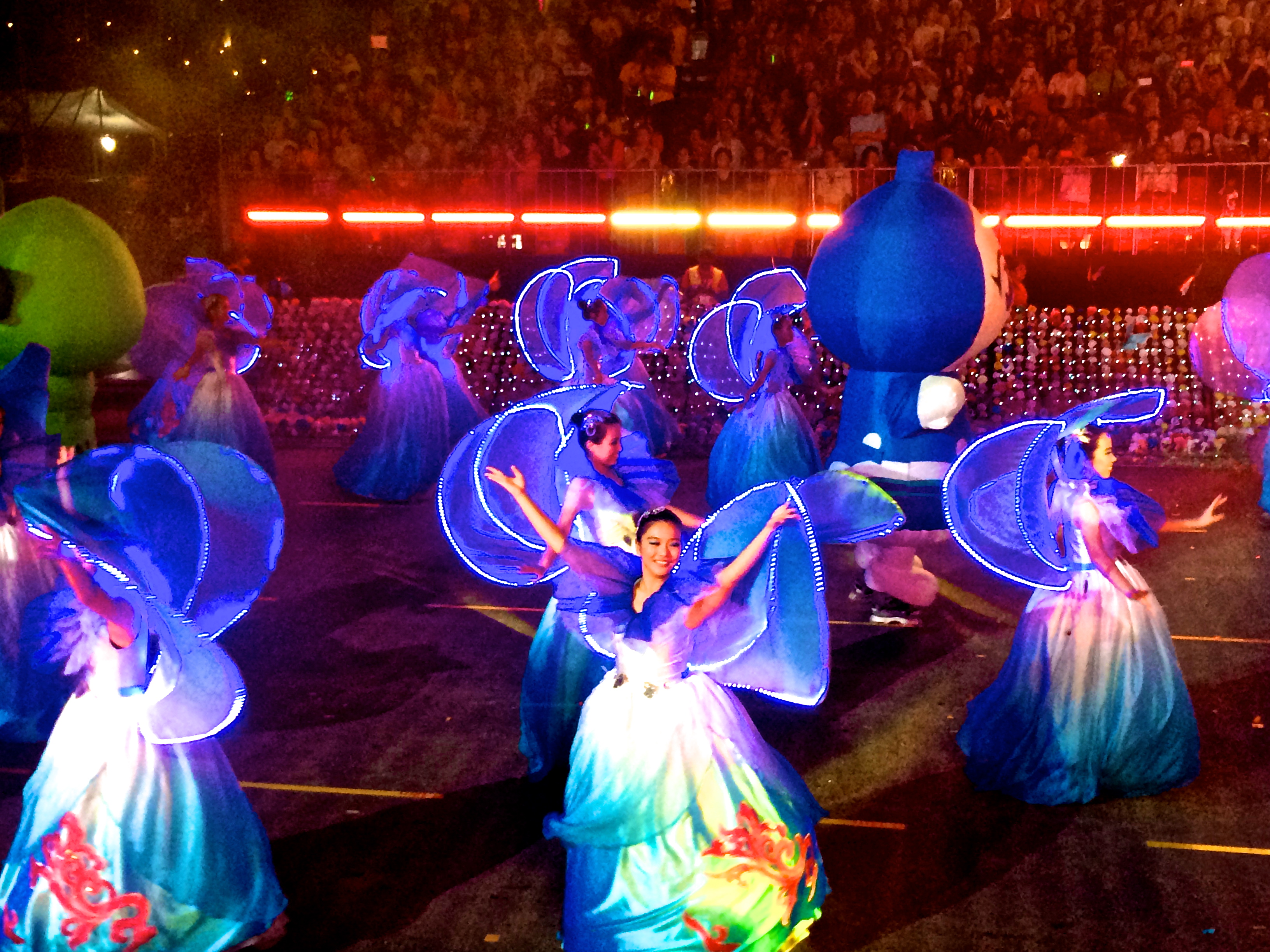
Hundreds of colorful dresses with lit-up wings didn’t fail to impress the audience.
Continuing on the topic of community involvement as well as environmental friendliness, the final part of the show opened with a showing of 150 lighted trees and three tree floats with lighted We <3 SG flowers. The trees were created by Singaporean communities and each lit flower was skillfully crafted from used plastic bottles. These were presented by 3,000 performers in lighted costumes to the beautiful melody of “Dreams,” a song by a Singaporean singer and composer. This beautiful finale called Hopes & Dreams SG served as a last reminder of Singaporean love and pride for their country.
Chingay Finale: Trees of Hopes and Dreams
As people were leaving the parade to the sight of fireworks exploding in the night sky, it wasn’t hard to tell how impressed everyone was with Chingay 2015. The event turned out to be as unique and colorful as promised, truly a celebration of Singaporean identity.
“My favorite part of the parade was definitely the founder’s float. I loved the Hawaiian shirt and the fireworks as the cake topper!” Russ said.
The Chingay parade has become a large-scale, international event that keeps growing in exuberance and energy every year. The only question on everyone’s mind remains the same: how can Singapore top its 50th birthday celebration?