Tuesday, 23 June 2015

The Projector transforms the movie experience in Singapore


When I walked up to the fifth floor of Golden Mile Tower on 6001 Beach Road, I saw a welcoming sunlit foyer with panoramic windows and a small cinema café. Here it was, The Projector, a new independent cinema that promised its visitors a truly hipster movie experience.
Photo contributed by Pieter van Goethem
I was lucky to meet The Projector’s manager, Sharon Tan, who told me about the concept behind creating this grandiose project.
“The idea was born out of our love for old, undiscovered spaces, coupled with our desire for an alternative venue in Singapore that would bring people together for great films, unique experiences, creative vibes and good fun. Tired of hearing ourselves and others moan about the film and entertainment offerings on our shores, we felt that with the right team and the right space, we stood a good chance at creating one!” Tan said.
So what exactly makes The Projector unique?
The Projector consists of two movie halls, Green Room and Redrum (that’s right, just like in Kubrick’s “The Shining”). While the Green Room is used just for films, the Redrum also serves as a space for events, private screenings, and so-called “experience.” In addition to cinema seats, there are tables and cushions in the Pit, as well as a small stage. The Redrum is available for rental if you want to host a private party or organize a large-scale performance.
It’s a self-funded project. Sharon Karen & Blaise are a group of friends who transform overlooked spaces into relevant concepts to bring them back to life. What does this mean for you? Although sometimes there is no set ticket price for films shown in the Redrum, you can donate however much you wish. Generous donations are encouraged because the founders want to make this cinema a better, more unique place. As for Green Room showings and some Redrum events, you can find prices on The Projector’s website http://theprojector.sg/ or Facebook pagehttps://www.facebook.com/TheProjectorSG.
Hipsters, rejoice! The Projector redefines today’s commercialized cinema experience by showing foreign, indie, and alternative films so you won’t see any mainstream movies here.
Photo contributed by Philipp Aldrup
There is no more need to find a place to get coffee before going to the movies. The Projector’s partners, Group Therapy, welcomes everyone to the foyer café. Here you can find a variety of quality coffee as well as some baked goods and popcorn to munch on. They also sell ice cream by the jar. How cool is that?
photo
photo (1)
“My favorite thing about this project is getting to meet a lot of people who are quietly passionate about film. Because you don’t see them often, you think that they don’t exist. Apparently, they do,” Sharon said.

The Projector
Address: #05-00, Golden Mile Tower, 6001 Beach Road, Singapore 199589
Hours: 11:00 am – 11:00 pm

Busting common myths about raw food


“Eating raw food means eating like a hamster.”
“How do you live on raw foods alone? You won’t have energy, right?”
These are two common misconceptions about raw foodism. Not only are they not true, but living on raw foods alone is an extreme that is not being promoted here. Instead, simple open-mindedness about a raw food diet is what matters most.
The December article “Mood for Food: Afterglow surprises with a raw vegan menu”introduced readers to Afterglow, a local farm-to-table organic restaurant. The co-founder and manager, Carmen Low, was eager to bust some common myths about raw foods.
Myth #1: RAW FOOD IS JUST PLAIN VEGGIES
Question: What do you think raw food/clean eating is?
Student Responses:
“Sashimi,” answered sophomore Avery Kwik.
“Just unprocessed stuff with no genetically modified organisms (GMOs). You grow your own veggies, nothing from the supermarket. Pure fruits and veggies and homemade stuff,” said senior Jessica Allen.
Myth busted by Carmen Low:
“Contrary to the popular belief, raw or healthy food doesn’t have to be boring. Sure, organic fruits and veggies are at the base of clean eating, but they definitely don’t define it.
For example, at Afterglow, the most popular dish is the Kimchi Nori Rolls, which are made with homemade seven-days aged kimchi and crushed almonds instead of rice. Another restaurant favorite is Raw Lasagna, which is made of thinly-sliced zucchini instead of pasta, cashew cream that replaces cheese, and marinara sauce instead of processed tomato sauce.
Also, if you’re following a raw food diet, it doesn’t mean that you can’t have dessert. Chocolate Salted Caramel Fudge is here to prove this: it’s made of cocoa, avocado, tahini spread, and walnut crust.
Surprisingly, all of these dishes are fully raw and as you can see, none of them are boring salads.”
IMG_0325_2
Kimchi Nori Rolls
Myth #2: RAW FOOD IS FOR VEGETARIANS

Question: Do you think that raw food is mostly for vegetarians? Would you personally go to a raw food restaurant?
Student Responses:
“I think that there could be many meat eaters that would be interested in what raw food has to offer and the ideas behind it, but vegans/vegetarians would most likely be the ones who actually do the diet. However, I’d love to try going to such a restaurant,” answered senior David Riegger.
“I think other people can have raw food, but I’d say that it’s mostly for vegetarians,” said senior Hayley Sparrow.
Myth busted by Carmen Low:
“A lot of people who come to Afterglow don’t know about the food that we make and most of them are not vegans or vegetarians. The whole concept of farm-to-table raw food restaurants is not about converting anyone and I, myself, am not a vegetarian, but I do enjoy healthy food tasting good. I don’t think that eating clean means eating like a hamster.
So if healthy food tastes good, I don’t see why people wouldn’t want to eat it on a regular basis. Not every night out should mean burgers and fried foods. Instead, it can mean ‘tiramisu with cashew cream’, ‘deconstructed sushi bowl’ , and ‘raw taco bowl’. Not only do these sound new and exciting, but they are also a good alternative to an old plain burger.”
IMG_0328_2
Raw Lasagna
Myth #3: RAW FOOD IS JUST ANOTHER HIP TREND

Question: Do you think that creators of raw food restaurants have first-hand experience with food issues that might have inspired them to share this knowledge with others or are they following a new food trend?
Student Responses:
“I think they’re just following the people and the trends and what’s hip,” said sophomore Izak Arwan.
“I think that the creation of healthy, raw food restaurants has to do with people getting more educated about what they should be eating. Nowadays, even at regular restaurants, healthy options are being demanded by the general public. Therefore, knowing what the public wants is the trick to any successful business,” answered senior Rafaela Peterson.
Myth busted by Carmen Low:
“The inspiration behind the creation of this particular farm-to-table raw food restaurant has to do with my own person experience. My partner and I spent the last four years in China, still a developing country, where there were a lot of food scandals. It’s different from Singapore where the authorities are strict about hygiene safety.
In China, on the other hand, the source of the food should always be questioned. I worked in the communications industry so I did a lot of socializing and got a chance to see not-so-safe food factories. This made me realize how much better it is to eat farm-to-table foods, which became the reason to visit organic farms and to do research on how to make healthy food taste better. “
Chocolate Salted Caramel Fudge
Myth #4: THERE ARE NO ORGANIC FARMS IN SINGAPORE

Question: Do you think there are organic farms in Singapore?
Student Responses:
“There aren’t a lot of farms in Singapore, but there are some and I’m guessing there is at least one organic farm,” said senior Gabby Leow.
“I think there are natural plants like coconuts that grow in Singapore, but I don’t think they have any organic tree or animal farms on such a small island. Singapore imports all of its organic plants,” answered junior Maggie Bryan.
Myth busted by Carmen Low:
“We work with a lot of organic farms in Singapore; however, this makes us depend on the weather. Although this can be difficult, it also allows us to be creative. Our menu changes constantly since our ingredients are whatever is in season at the moment. Another benefit we get from personally going to the farms we work with is the exchange of knowledge that happens there. Farmers and I often tell each other what we know about growing organic crops so in a way, this is an exchange of not only crops, but also information.”
IMG_0311_2
After eating at Afterglow and interviewing the owner, this reporter feels more knowledgeable and excited about raw food than ever. Not only is it anything but boring, but it’s also just as accessible and affordable as your typical PS Cafe burger.

See Da Vinci: Shaping the Future exhibit before it leaves Singapore


What do we know about Leonardo da Vinci? He is the guy who painted the Mona Lisa and The Last Supper, as well as someone who gets the term “the Renaissance Man” constantly assigned to him. Unfortunately, this vague view of da Vinci is common among most people.
What’s truly ironic is that no matter what one studies at school or what job one holds, everyone should be familiar with at least some aspects of Leonardo da Vinci’s work. Having studied painting, sculpture, architecture, music, mathematics, engineering, anatomy, geology, cartography, botany, and writing, da Vinci left an impact on almost every subject area imaginable. Indeed, he holds the title of the Renaissance Man for a reason.
“Da Vinci: Shaping the Future” is a unique exhibition that presents us with da Vinci’s journey as a polymath. It will run daily 10:00 a.m.-7:00 p.m. until May 2015 at the ArtScience Museum at Marina Bay Sands. At just $19.00 for a regular ticket, we are given a chance to explore five areas of Leonardo’s work: mathematics, natural sciences, architecture, technology, and music.
The world’s largest collection of Leonardo’s writings and drawings, the Codex Atlanticus, awaits you at the end of the exhibition. These original works have been studied by experts for centuries, and after traveling across the world, they have finally made it to Southeast Asia.
Warning: this is not an exhibition that you can just walk through without thinking. It requires you to open your mind and explore the different aspects of da Vinci’s work.
MATHEMATICS
What you’ll see: geometrical diagrams of platonic solids and toothed wheel as well as attempts of squaring a circle
For Leonardo da Vinci, mathematics was a subject that could be applied to both art and science. Although initially da Vinci simply experimented with geometric forms, he did find a practical use for them. In art, geometric patterns developed into decorative designs. As for science, da Vinci used mathematics to transform straight lines into curved ones because he viewed straight lines as something artificial that does not exist in nature. His unique approach also led him to find solution in transformation, or geometry in motion. For example, he was famous for trying to construct a square with the same area as a circle.
As a result, da Vinci’s works became an early form of topology, an important field in modern mathematics.
Sketch of a toothed wheel. Photo by Anna Sorokina
NATURAL SCIENCE
What you’ll see: sketches of anatomical dissections and water movement, studies of the human eye, and models of flight machines
Leonardo da Vinci was fascinated by nature. He studied the movements of water and air, as well as geological forms and botanical diversity of the earth. He would use his understanding of water’s properties to develop hydraulic tools. In his botanical studies, he linked natural phenomena to painting, which reflected his belief that science and art could not be viewed in isolation.
He was also captivated by the beauty of the human body, its proportions and movement. Although da Vinci started studying anatomy to accurately represent the human body in his paintings, he was soon dissecting cadavers at hospitals for the sake of science. Similarly to his fascination with human body, he studied the form and function of birds and their wings, which eventually influenced the design of his flight machines. Da Vinci believed that only through careful observation could one obtain true knowledge, an approach that he used in all aspects of his studies.
Sketch of anatomical dissection. Photo by Anna Sorokina
Da Vinci's first attempted  flight machine. Photo by Anna Sorokina
Da Vinci’s first attempted flight machine. Photo by Anna Sorokina
Da Vinci's studies of birds influenced the design of his flight machines. Photo by Anna Sorokina
Da Vinci’s studies of birds influenced the design of his flight machines. Photo by Anna Sorokina
Photo by Anna Sorokina
ARCHITECTURE
What you’ll see: model of ideal city and sketches of urban planning
Da Vinci used his understanding of the natural world and of human anatomy in creating man-made constructions. He viewed the city as the human body, each component of which had to be healthy for it to function. Besides constructing cities, da Vinci used principles of art, science, and technology to design military fortifications. To create centrally planned churches, da Vinci experimented with the principles of geometry to create both practical and elaborate designs.
TECHNOLOGY
What you’ll see: models of military fortifications and da Vinci’s unique bridge design
It is no surprise that Leonardo da Vinci treated machines as intricate organisms which he designed according to perfect proportions. As an engineer at the court of Milan, da Vinci created dozens of civic tools, helped by his observations of construction sites. Da Vinci’s technological projects were as beautiful as they were functional. Though he was a pacifist, da Vinci was asked to engage in many projects on military strategy.
Military fortifications. Photo by Anna Sorokina
MUSIC
What you’ll see: musical instruments invented by da Vinci and animations of sound waves
When Leonardo da Vinci arrived at the court of Milan, he presented himself as a musician.
He used his studies of projectile motion in military machines to describe sound travel and looked into optics for sound echo and reflection. Not only did da Vinci observe sound travel in different mediums such as water, but he also compared the design of musical instruments to the anatomy of the throat. This, once again, demonstrates his desire to connect all the disciplines that he studied.
Musical instrument invented by da Vinci. Photo by Anna Sorokina
So why the name “Shaping the Future”, you ask?
Da Vinci’s ability to find connections between seemingly unrelated disciplines creates the world we live in today. As proof of this, scattered across the exhibition are five installations by contemporary artists, each one of whom drew inspiration from da Vinci’s work. Coming from the UK and Singapore, their installations reveal different ways to apply da Vinci’s thinking to the modern world.
Glass Microbiology by Luke Gerram. Photo by Anna Sorokina
Looking Through the Glass by WY-TO. Photo by Anna Sorokina
________________________________________________________________________
Daily: 10:00am – 7:00pm
Including public holidays
Last admission at 6:00pm

Public Guided Tours
Saturdays: 11:30am & 5pm
Sundays: 11:30am

Mood for Food: Sushi Burrito


How not to get caned in Singapore


Illustration by Hong Bin Jeong
You have heard about judicial caning in Singapore, but do you know what acts are punishable with caning and how to avoid getting sentenced?
In 1994, the story of Michael P. Fay went viral. This 19-year old American student from SAS was sentenced for vandalizing cars. The teenager spent four months in prison and received four strokes from a four-foot-long, six-inch-wide rattan cane.
According to Singapore Penal Code website, vandalism is defined as “writing, drawing, painting, marking or inscribing on any public or private property without permission” as well as “stealing, destroying or damaging any public property.” The minimum amount of strokes one can be sentenced to is three; the maximum is eight.
Vandalism is one of the most common public offenses and probably the one SAS students should be most aware of, but it’s not the only one. There are some obvious crimes resulting in caning, such as rape, attempt to murder, and kidnapping. However, there are also some not-so-obvious ones.
SAS students were asked if they knew what offenses were punishable by caning.
“You get caned for rape, that’s for sure,” said senior Bryce Ueling. “Not for stealing.”
“I think minors get caned if they steal things… also for underage drinking?” said junior Tia Abdi.
“Drug distribution, not drug use though,” said senior Kaity Holl.
It turned out that SAS students don’t know much about caning. So what are the not-so-obvious crimes that could result in this Singaporean punishment? The following are listed on the Singapore Penal Code website:
-Entering or remaining in Singapore without a valid pass (3-24 strokes)
-Illegal overstayers for a period exceeding 90 days (3-24 strokes)
-Trafficking of a minimum quantity of drugs (2-15 strokes)
-Repeat consumption of specified drugs (3-12 strokes)
-Robbery (12-24 strokes)
-Attempt to commit robbery (6-24 strokes)
-Piracy (12-24 strokes)
-Sexual penetration of a minor (12-24 strokes)
Caning is normally confined to males between the ages of 16 and 50. However, this doesn’t mean that younger boys don’t get punished. The procedure for caning boys under 16 in Singapore is the same as for adult men, except that a smaller rattan is used. Caning is also a legal method of punishment of male youths in Singaporean schools.
Even though women are not subject to judicial caning, punishment of children of either gender by caning is used by some parents in Singapore and is allowed by the government.
While Michael Fay’s punishment was the minimum according to World Corporal Punishment website, it still left a “few streaks of blood” and three permanent scars, as he related to reporters after the event. So if you like graffiti, be warned: it would be safer to abstain from displaying your talent on public or private property or anywhere in this country.

Truth about headphones and hearing


What is your iPod doing to your ears? Illustration by Hong Bin Jeong
Tuned into what he wants to hear, tuned out of the world around him–this describes the typical Singaporean teenager spotted on one of the trains of the MRT. Jay Z’s voice was blasting in his headphones and could be heard by everyone around him. Everyone who was still tuned into this world, that is. Unsurprisingly, they were the minority.
Ten music lovers on the MRT were asked how loudly they were playing their music. Four out of 10 said that it was at 60 percent, three admitted that it was at 70 percent, two people had it set to 80 percent, and one had his at 100 percent. Although this experiment was not scientifically valid due to the small group of participants, it still has value. On the MRT, it is obvious that Singapore teens spend a lot of time listening to music. However, how many hours a day is considered a lot? And what do these volume percentages mean anyway?
GenerationDeaf, a Noise Induced Hearing Loss awareness website, provides information about the hazards that iPod use. According to the website, if you listen to music at 10-60 percent of the maximum iPod volume, you are on the safe side and therefore can be plugged in virtually 24/7 with no harm to your eardrums. Those who prefer their music at 70 percent should not worry too much either; they won’t go deaf as long as they limit their daily dose of Jay Z to four and a half hours. However, if none of the above sounds like you, you should start paying attention to your music habits.
Seventy-two minutes is a bit more than one train ride from Woodlands to Marina Bay, and it’s also the maximum time your ears can handle at 80 percent of the maximum volume level.
If you like to enjoy your music at 90 percent, you expose yourself to 95 decibels of sound pressure. This amount of pressure is equivalent to listening to a jackhammer – something you should not do for more than 18 minutes a day.
The loudest possible volume is somewhere between standing next to a working motorcycle and going to a rock concert. Maximum exposure: five minutes. One song on your iPod at this ear-splitting volume and you are done for the day.
Now you can see why so many people should be concerned about their music listening habits. Thirty percent of experiment participants are at danger of developing irreversible Noise Reduce Hearing Loss if they continue listening to music at 80 percent or more.
What can you do? You can simply remind yourself not to go overboard with the volume when listening to music. As GenerationDeaf states, many experts suggest the 60/60 rule, listening at 60 percent of maximum volume for 60 minutes a day. So if you follow this rule, your ears will be safe. However, if you don’t trust yourself with this, you can just set the volume limit on your iPod. By listening to the experts’ advice, you may continue to hear what is playing on your iPod for years to come.


The two-hour Chingay Parade passed by quickly as 180,000 pairs of eyes watched colorful cultural dances and mesmerizing fireworks from the stands. Whether it was Southern Lion Dance or Pole Act flag balancing, the famous parade didn’t fail to amaze its visitors.
The Chingay Parade made its way through the Formula One Pit Building on Feb. 27 and 28. This annual street parade, held as part of the Chinese New Year celebration, is the largest street performance in Asia. The name “Chingay” comes from the Hokkien dialect of Chinese and means “the art of costume and masquerade.” With its roots tracing back to China, this event was inaugurated in Singapore in 1973. Back then, the celebration consisted strictly of Chinese customs and traditions, featuring dragon dances, martial arts and street opera.
In 1987, Chingay invited a foreign group to perform at the parade for the first time. Four pop singers from Tokyo opened this event to the international entertainment arena, making it possible for other cultures to participate.
25 years ago, Chingay parade celebrated its Silver Jubilee with Indian classical dance, Japanese rock-and-roll, and five Alice In Wonderland-themed carnival floats.
In 2004, for the first time in the parade’s history, 18 firecrackers were set off, starting a great tradition of yearly fireworks. That year, the number of displayed floats rose to 16, while the number of performers skyrocketed to more than 3,000.
For many years, the parade covered only central areas of Singapore such as Orchard Road, Chinatown, and City Hall, but it recently moved to the Formula One Pit Building at the Marina Waterfront. This is due to the growing popularity of the event as well as its large scale.
It is no surprise that Chingay 2015 is considered to be the grandest in history. Not only did it celebrate Singapore’s 50th jubilee, but it also showcased 11,000 performers and attracted about 180,000 visitors.
However, Chingay’s large number of participants and visitors is not the only thing that brought success to year 50. The parade’s unique organization also made it stand out from the previous years. It was divided into four segments: Celebration SG, Memory SG, We <3 SG, and Hopes & Dreams SG.
The first segment of the parade couldn’t have happened without the help of a nine-month Community Engagement Program. Through this program, Singaporeans crafted one million colorful flowers from used plastic bags. The flowers were a part of a ‘gigantic flower bed’ that represented people’s wishes for the nation.
“My first impression of the parade was that it was extremely loud, colorful, and patriotic. A lot of hard work was put into the dance routines,” said junior Savanah Russ.
IMG_5504
The parade opened with a gorgeous float “We Love SG”.
Memory SG marked the first part of the parade by telling visitors about Singapore’s history from early ‘60s to the present. Symbolic of the 50th anniversary, Memory SG was meant to evoke a sense of nation’s pride.
"Together we celebrate 50 years of diplomatic relations between Singapore and India."
“Together we celebrate 50 years of diplomatic relations between Singapore and India.”
Besides expressing their own love for the nation, Singaporeans got to see foreign communities and organizations in celebration of the country’s 50th birthday. We <3SG showcased thousands of foreign performers from the Association of Southeast Asian Nations (ASEAN) as well as from Russia, Turkey, Rwanda, China, India, and South Korea. From Latin American ballroom samba to Golden Dragon Dance, parade visitors had a chance to see a variety of entertaining acts that made the third segment of the event a truly memorable experience.
IMG_5574 - Version 2
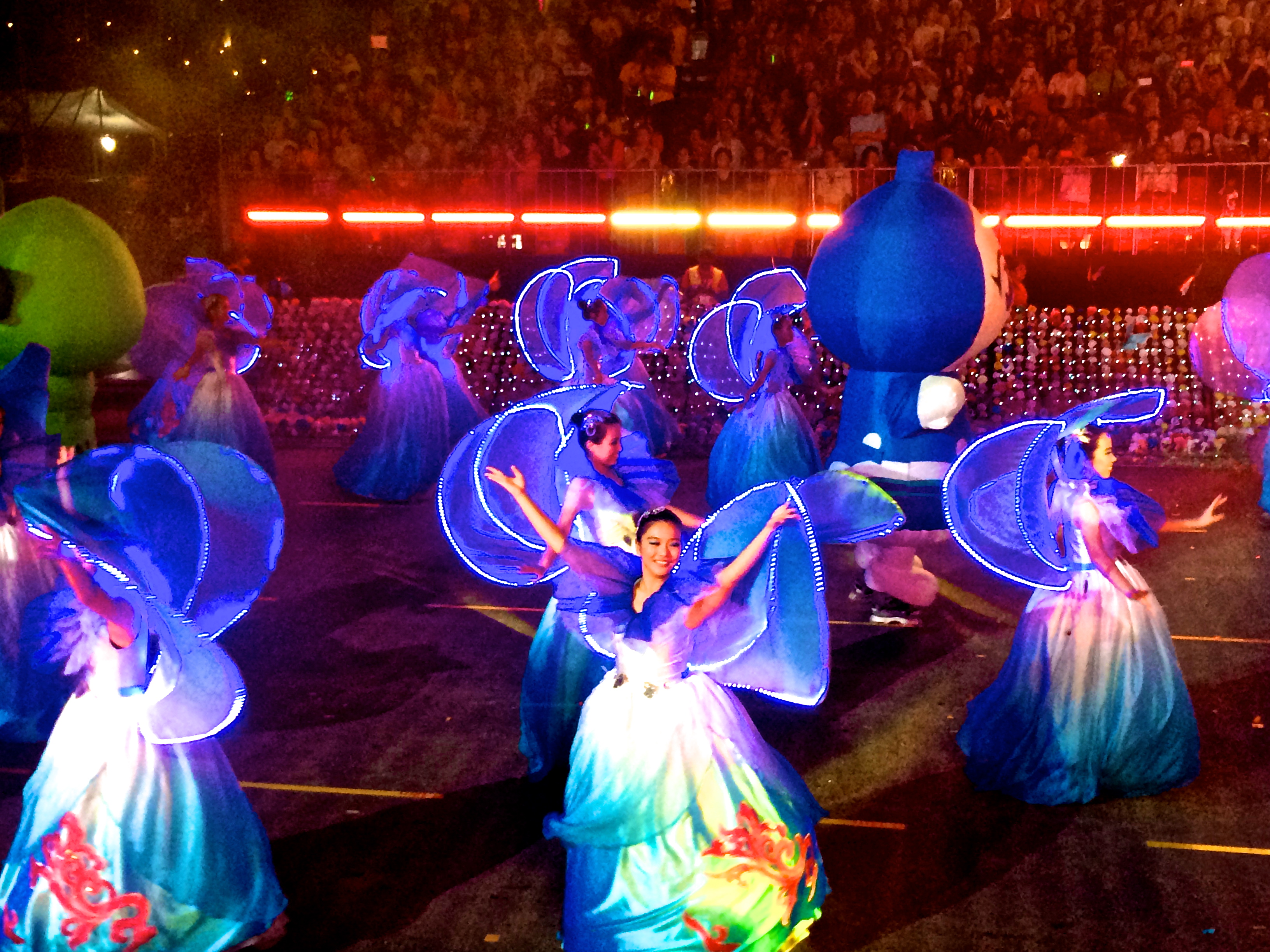
Hundreds of colorful dresses with lit-up wings didn’t fail to impress the audience.
Continuing on the topic of community involvement as well as environmental friendliness, the final part of the show opened with a showing of 150 lighted trees and three tree floats with lighted We <3 SG flowers. The trees were created by Singaporean communities and each lit flower was skillfully crafted from used plastic bottles. These were presented by 3,000 performers in lighted costumes to the beautiful melody of “Dreams,” a song by a Singaporean singer and composer. This beautiful finale called Hopes & Dreams SG served as a last reminder of Singaporean love and pride for their country.
Chingay Finale: Trees of Hopes and Dreams
As people were leaving the parade to the sight of fireworks exploding in the night sky, it wasn’t hard to tell how impressed everyone was with Chingay 2015. The event turned out to be as unique and colorful as promised, truly a celebration of Singaporean identity.
“My favorite part of the parade was definitely the founder’s float. I loved the Hawaiian shirt and the fireworks as the cake topper!” Russ said.
The Chingay parade has become a large-scale, international event that keeps growing in exuberance and energy every year. The only question on everyone’s mind remains the same: how can Singapore top its 50th birthday celebration?